Glossary
Terms used on WattleGrow, in plain words. Each definition comes from an Australian institution; the sources are at the foot of the page.
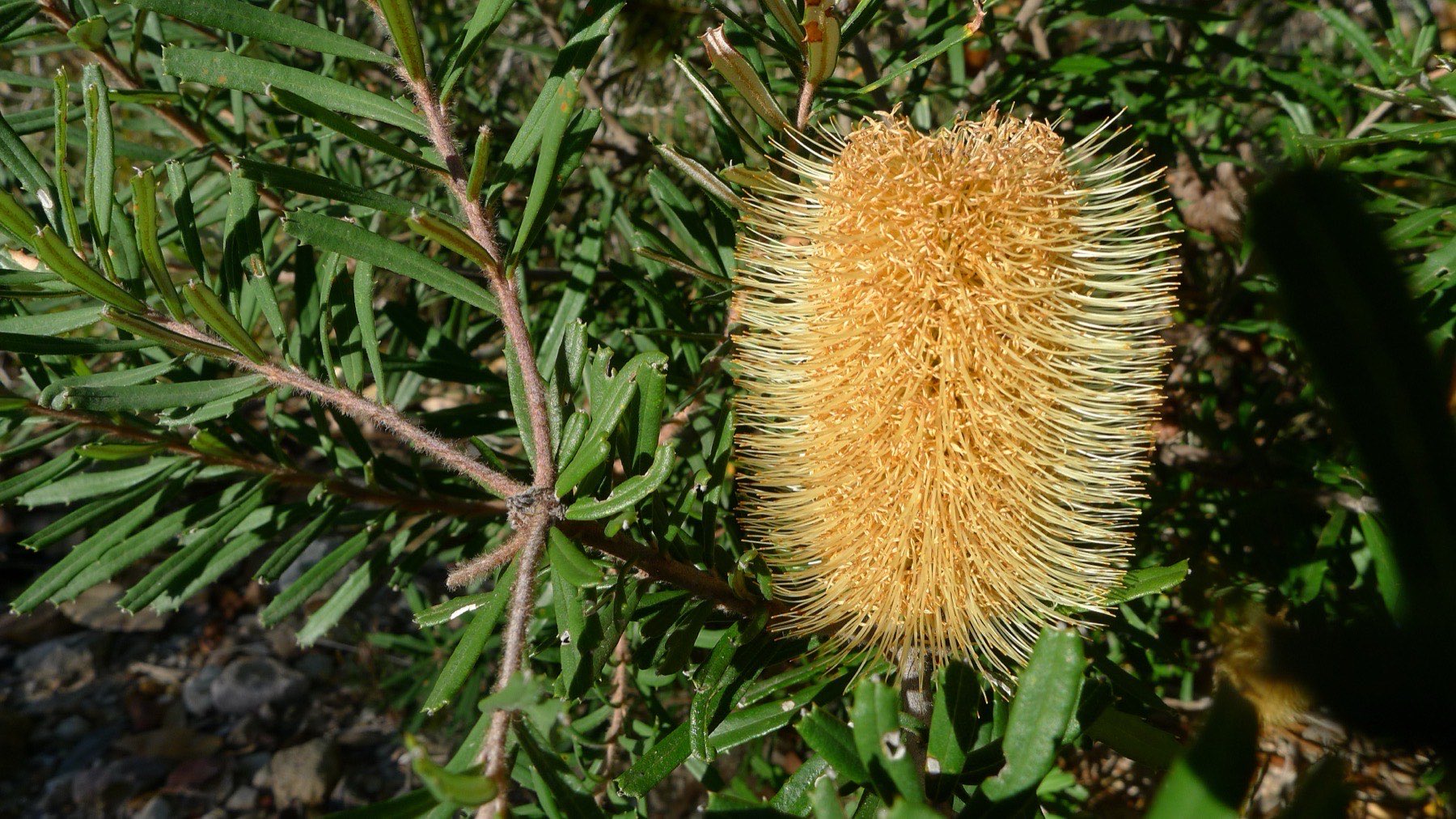
Silver banksia (Banksia marginata) flower spike. Photo: John Tann, CC BY 2.0.
.jpg)
Plants and their names
- Native
- A plant that grows wild somewhere in Australia and was not introduced from overseas.A native from Perth can still be a weed in Rosebud.Australian Native Plants Society
- Locally indigenous
- A plant that occurs naturally in your specific area, so it is suited to the local soil and climate. Native plants "are not considered to be indigenous when planted beyond their natural habitat".Junior Landcare, Victorian Landcare Program
- Endemic
- Known naturally from one place and nowhere else. The Australian National Botanic Gardens uses it for plants known only from Australia; the same idea applies at smaller scales.Australian National Botanic Gardens
- Species and subspecies
- A species has a two-part scientific name, genus then species, in italics. A subspecies is a natural variant within a species, usually tied to a region, written with "subsp." after the species name.Australian Government Style Manual
- Cultivar
- A garden variety deliberately selected or bred for particular traits, which keeps those traits when propagated. Written after the species name, capitalised, in single quotes: Correa 'Dusky Bells'.Australian Cultivar Registration Authority; Australian Government Style Manual
- Hybrid
- A plant produced by crossing two different species or cultivars, combining traits of both parents. Natural hybrids carry an × between genus and species.Australian National Botanic Gardens
- Provenance
- Where a plant's seed originally came from in the wild. "Local provenance" means seed collected as close as practical to where it will be replanted, so it matches local genetics and conditions.Florabank Guidelines
In the nursery
- Tubestock
- A young plant grown in a narrow, deep pot, a "forestry tube", ready to plant into the ground rather than a garden pot.Florabank Guidelines, Module 13
- Cell tray
- A propagation tray divided into small cells, each growing one seedling that lifts out as a plug with its own root ball. "Hiko" is a trade name for one common style.Florabank Guidelines, Module 13
- Hardening off
- Gradually toughening a nursery-raised plant to sun, wind and temperature swings over several weeks before it goes in the ground.Florabank Guidelines, Module 13
- Direct seeding
- Sowing native seed straight into the ground on site instead of raising plants in a nursery first.Florabank Guidelines, Module 14
- Revegetation
- Deliberately replanting or reseeding an area that has little or no native plant cover left.Victorian Catchment Management Authorities, Climate Ready NRM
Land and vegetation
- Bioregion
- A large area with broadly similar climate, geology, landform and native plants and animals. Australia is mapped into 89 of them; the Peninsula sits in the Gippsland Plain.DCCEEW, Australia's bioregions (IBRA)
- Ecological Vegetation Class (EVC)
- Victoria's standard way of classifying types of native bushland, grouping plant communities that naturally occur together in a particular kind of environment.Goulburn Broken Catchment Management Authority
- Environmental weed
- A plant that harms bushland and biodiversity but has no formal legal status.Victorian Resources Online
- Declared noxious weed
- A plant Victoria has listed under the Catchment and Land Protection Act 1994, which legally requires landholders to control it. A weed can be both environmental and declared.Victorian Resources Online
In the garden
- Mulch
- A layer of organic material over the soil to hold moisture and suppress weeds. For natives, no deeper than about 75 mm; thicker can starve the soil of oxygen.Australian Native Plants Society
- pH
- How acidic or alkaline the soil is, which controls the nutrients plants can take up. Most plants prefer 6 to 7.5, but tolerance varies by species, so pH should guide plant choice.Victorian Resources Online
- Drought tolerant
- A plant that survives dry periods through its own adaptations, such as tough or waxy leaves and efficient water use, rather than extra watering once established.Which Plant Where, Western Sydney University and Macquarie University
On WattleGrow
- In stock
- Available at the nursery now. Appears in local search.WattleGrow
- Low stock
- Nearly gone. Still appears, flagged so nobody drives an hour for the last two.WattleGrow
- Incoming
- The nursery has ordered the plant or is growing it, but it isn't available yet. Shown with an approximate date.WattleGrow
- Verified
- A horticulturist has confirmed the plant-to-region match, or several independent reports agree.WattleGrow
- Member reported
- A gardener reported the plant growing in that area; not yet verified, and no guarantee of success.WattleGrow
Sources
- Australian Native Plants Society, Definition of an Australian native plant; Mulch and native plants
- Junior Landcare (Victorian Government-backed), Information sheet 3: What are indigenous plants?
- Australian National Botanic Gardens, Endemic Australian bryophytes; Natural hybridisation
- Australian Government Style Manual, Plants and animals
- Australian Cultivar Registration Authority, What is a cultivar?
- Florabank Guidelines, Guideline 5; Module 13; Module 14
- DCCEEW, Australia's bioregions (IBRA)
- Goulburn Broken Catchment Management Authority, Introduction to the EVC information sheets
- Victorian Resources Online, Invasive plants glossary; Soil pH
- Victorian Catchment Management Authorities, Climate Ready NRM planning
- Which Plant Where, What makes a plant drought or heat tolerant?